

How to List a Token or Coin on HTX
 September 10, 2025
 Updated: June 2 2026, 11:29

LEAVE A REQUEST
Launching your own token project? Our experts are ready to help with listing on exchanges, market making, marketing and other solutions
SUBMIT APPLICATIONHTX, formerly known as Huobi, is a centralized crypto exchange launched in 2013. Listing a token on HTX requires structured preparation across legal documentation, tokenomics, technical security, liquidity planning, and launch marketing. This guide explains the available listing routes, required materials, application steps, and common mistakes to avoid.
For full-cycle support, explore our HTX listing service.
What Is HTX and Why List There?
The HTX exchange was launched in China in 2013. It is now one of the leading exchanges in the Asian and global markets. It has record trading volumes and a vast user base of more than 50 million people. A large number of tokens are traded on the exchange. The number of available trading pairs is more than 1000.
HTX has strict selection standards for new tokens, but at the same time, it can provide significant marketing support for listings.
Listing options on HTX
Depending on the project and the exchange’s current programs, the listing route may include a direct spot listing or an ecosystem campaign such as Launchpad or Launchpool.
Direct spot listing is suitable for most projects. With this option, the project team fills out a listing application and provides all the necessary documents. During the due diligence stage, the exchange reviews the documents provided for transparency and compliance with all requirements.
The ecosystem campaigns are suitable for projects seeking rapid growth and increased reach. The project is placed on Launchpad/Launchpool, allowing it to attract additional investor attention and increase the coin’s visibility.
Before choosing a listing route, review the typical HTX listing costs to understand the budget and plan the process accordingly.
HTX selection criteria: what the exchange checks
When reviewing a project, the HTX team will check the following details:
- Company legal documents. Transparency and legal status in your jurisdiction. Compliance with all established KYC and AML requirements.
- Tokenomics. The team will check the transparency of tokenomics, the presence of vesting, and the fairness of coin distribution.
- Projects should prepare an up-to-date smart contract audit from a recognized security firm.
- It is essential to show the existence of a product or MVP. The exchange needs to see that you are developing a product and can show a working version of it.
- A realistic launch marketing plan with specific pre-listing and post-listing activities. The more detailed it is, the better. The exchange needs to understand that after listing, you will continue to develop the project and work on growing the community.
- Prepare an initial liquidity plan covering target trading pairs, depth expectations, and the role of an experienced market maker.
- The exchange will check the team’s previous experience and reputation. Information about the team must be open. This makes the project more trustworthy for both the exchange and investors.
For a complete checklist, read our HTX listing requirements guide.
Preparing for token listing
Now that you understand what the exchange will check, you need to prepare a package of documents to send along with your application.
| Document | Why it is needed | What is checked during verification |
| Whitepaper | A detailed description of the project’s goals, concept, roadmap, and technical nuances. | The information must be complete and clear. After reading the whitepaper, the reader should not have any additional questions. |
| Tokenomics | Provides complete information about the token and its utility, including the number of coins in circulation, unlocking, and vesting schedule. | The exchange team evaluates the realism and transparency of the tokenomics. All details about the token must be disclosed. |
| Smart contract and information about its audit | Provides an understanding of the smart contract code’s contents and its security. | The exchange team most often looks at the audit company’s report. |
| Legal documents | Help confirm the legality of the project. | Check whether the information complies with regulatory requirements. |
| Audience activity and size | How active and engaged the project’s audience is | The exchange team checks that the data has not been inflated. It studies the activity of the community on the project’s official social networks. |
| Liquidity plan | Necessary to understand how the project will maintain the liquidity of the token after listing. | The team looks at the realism of the plan and the presence of a market maker. |
| Project promotion plan | Provides an idea of how the project will promote the token before and after listing. | The team looks at the budget and specific actions described in the plan. |
| Team contacts | Understanding who on the team is responsible for listing. | They look at the competence of the selected employee. It’s better to provide the CEO’s contact details. |
Step-by-step instructions for submitting an application
Once you have gathered all the necessary documents, you can proceed with submitting your application. First, ensure you have all the required elements in place: collected documents, a completed audit, a clear marketing plan with specific actions, and sufficiently transparent tokenomics.
Once you have gathered the documents, you can go to the official HTX listing form and start filling it out.
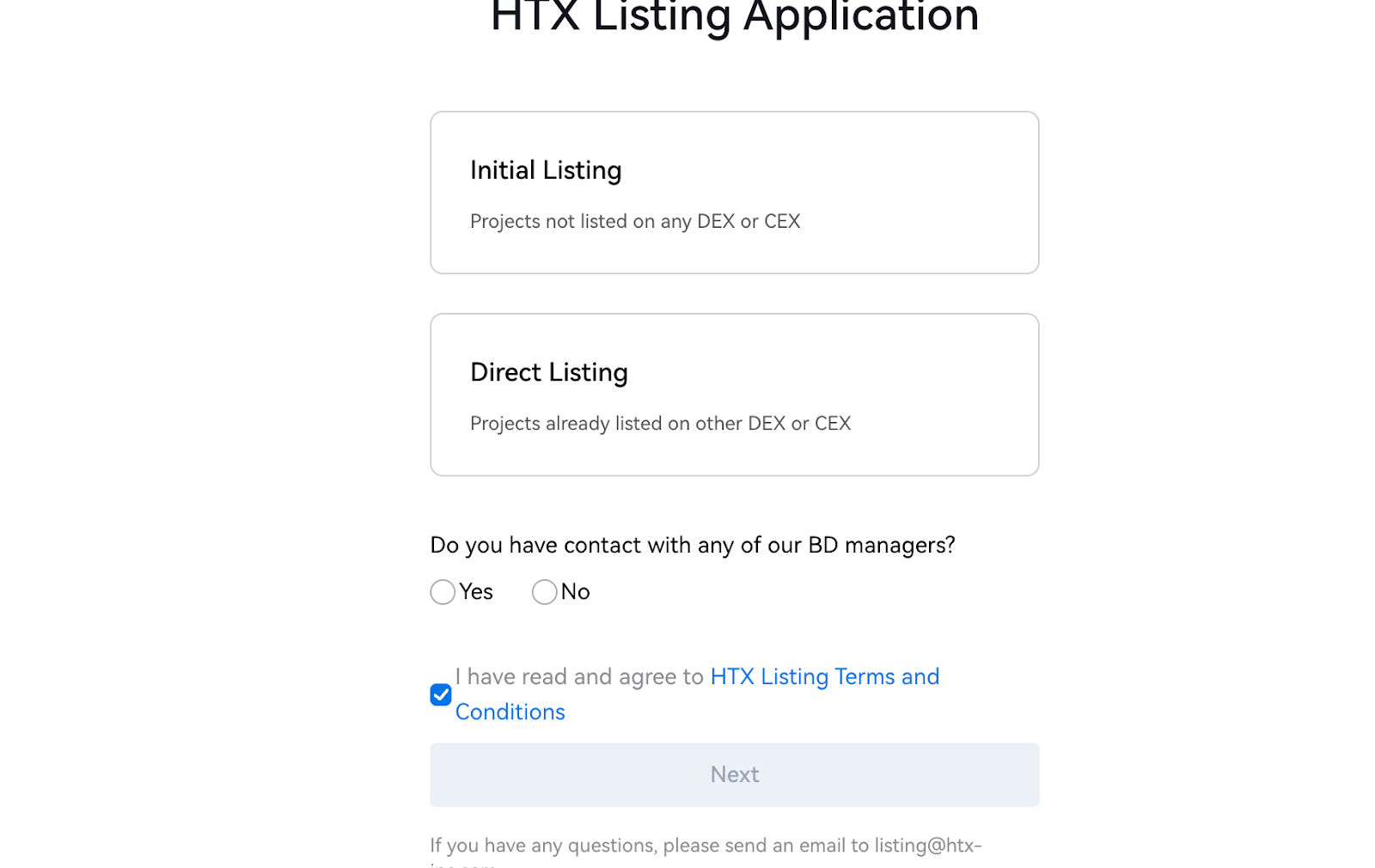
In the form, you will need to fill in basic information about the project, specify whether the token is traded anywhere else, or if this will be its first listing. Complete the application carefully and provide consistent information across all materials. Missing or unclear details may lead to additional questions during the review process.
After the application has been reviewed and approved, the exchange’s technical team will take over and perform the technical integration of the new token on HTX. They will check the smart contract and the functionality of the token deposit and withdrawal.
Once the technical integration is complete, the exchange may publish a listing announcement and coordinate available launch activities with the project team. This may include AMA sessions, trading activities, and other events that increase activity around the upcoming listing.
On the agreed date and time, trading will start, and the token will become available for trading to all HTX users.
Common mistakes and how to avoid them
Many teams facing token listing for the first time make the same mistakes. Knowing about them, you can better prepare for the upcoming listing. The following issues may complicate the HTX listing review:
- Do not have a smart contract audit.
- Have opaque tokenomics. For example, the vesting schedule may not be clearly stated.
- The package of documents is not sufficiently detailed. The whitepaper does not answer all user questions, and the legal documents raise doubts.
- Lack of a marketing plan or liquidity plan.
- Template answers to the exchange’s questions based on the results of the review.
If your team needs support, Listing.Help can help structure the listing process. We work directly with HTX and other exchanges, review project materials, coordinate communication, and support teams from the initial discussion to launch.

Conclusion
Listing a token on HTX requires more than submitting a form. Projects should prepare complete documentation, transparent tokenomics, a verified smart contract audit, a realistic liquidity plan, and clear launch activities. A structured application helps the exchange review the project efficiently and reduces avoidable delays.
If your project is preparing for an HTX listing, Listing.Help provides full-cycle support through direct communication with the exchange. We manage the process from the initial discussion to the listing launch and can also coordinate related services, including market making and launch marketing.


 April 25, 2026