

How to List a Token on Hyperliquid in 2026
 July 16, 2025
 Updated: May 26 2026, 05:45

LEAVE A REQUEST
Launching your own token project? Our experts are ready to help with listing on exchanges, market making, marketing and other solutions
SUBMIT APPLICATIONTo list a token on Hyperliquid, a project needs to deploy a HIP-1 token, acquire a ticker through the Dutch auction, set genesis balances, create a primary market, add liquidity, prepare metadata and coordinate launch communication.
Hyperliquid is permissionless, but execution still matters. The main challenge is not simply submitting a contract – it is launching with the right ticker strategy, liquidity depth, market making structure, technical setup, trader communication and post-launch monitoring.
What Is Hyperliquid DEX?

Hyperliquid is a high-performance DEX platform built on its own Layer-1 blockchain. Its distinctive feature is its on-chain order book. It brings the trading experience closer to centralized exchanges while maintaining decentralization.
The order book operates directly on the blockchain, ensuring complete transparency and high speed. Hyperliquid has its own HIP-1 and HIP-2 token standards, which work similarly to ERC-20 but are more adapted to the Hyperliquid architecture.
Thanks to the built-in liquidity system, trading pairs are created using an automatic market maker.
To use Hyperliquid, you don’t need to use third-party wallets — all operations can be carried out through the built-in wallet interface.
Perpetual futures are also particularly popular on Hyperliquid, offering traders leverage of up to 50x and low transaction fees.
Why List on Hyperliquid?
Listing a token on Hyperliquid can offer several significant advantages:
- Since all functionality is implemented through open smart contracts, all trading is transparent.
- Permissionless token launch, unlike centralized exchanges. Listing a token on DEX is faster.
- Hyperliquid utilizes a Dutch auction, a unique mechanism that distributes tokens and purchases token tickers.
- Another feature of the platform is the rapid addition of liquidity through the Hyperliqidity function.
- Listing on Hyperliquid opens up access to the active DEX exchange community, allowing the project to attract new investors and increase awareness.
What You Need Before Listing
To prepare your project for Hyperliquid listing, you will need to compile a complete package of technical and marketing information, including:
- A whitepaper describing the project’s mission, goals, and mechanics.
- Tokenomics with transparent terms for token distribution, vesting, and utility.
- To be listed on Hyperliquid, your smart contract must comply with the HIP-1 standard. In addition, the code must be thoroughly tested and, if possible, have passed a security audit by a trusted auditing company.
- Before listing, a test deployment (testnet) is required to verify the configuration’s correctness and interaction with the protocol.
- To participate in the Dutch auction and ensure liquidity, USDC will be required in the wallet.
- The developer may also need access to the GitHub Hyperliquid SDK and instructions on how to use the tools.
Before starting the launch process, review our Hyperliquid listing requirements checklist to make sure your HIP-1 setup, ticker strategy, liquidity plan, metadata and market making structure are ready.
Step-by-Step Token Listing on Hyperliquid Process
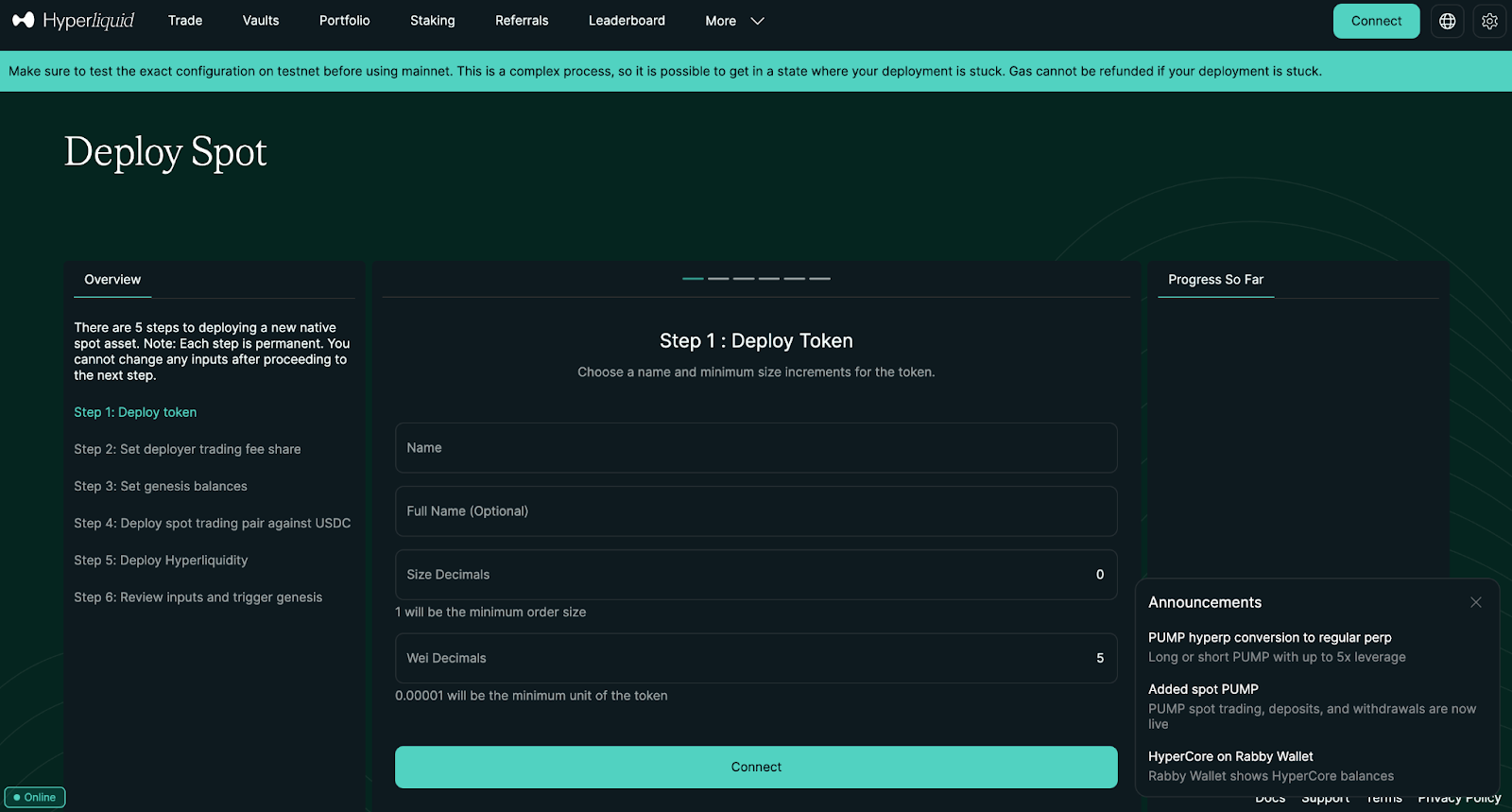
The process of listing a token on Hyperliquid is straightforward. The first step is to create a HIP-1 standard token. This is done in the developer interface using the Deploy Spot function. It is essential to enter the parameters correctly: name, ticker, total token supply, and the number of decimal places. It is necessary not to make a mistake at this stage, as the token will need to be recreated if an error occurs.
The next step is to set up Genesis balances, i.e., the initial distribution of tokens. At this stage, it is crucial to determine the list of addresses that will receive tokens, as well as the number of tokens reserved for the community, investors, and the liquidity pool. At this stage, you should have a ready-made tokenomics, so all the numbers can be transferred from there.
To obtain a unique ticker that is not yet in the system, you must participate in a Dutch auction. There, you need to buy an NFT in the name of the token that will be displayed in the order book. If the ticker is already taken, the launch will not be possible, so this step cannot be skipped.
For the full budget breakdown, including Dutch auction costs, liquidity, market making, audits, metadata and launch marketing, see our Hyperliquid listing cost guide.
The next step is to create a trading pair and add liquidity through the Hyperliquidity system. Most often, a trading pair is created with USDC. At this stage, it is essential to determine the initial liquidity volume, price range, and distribution strategy. Initial liquidity depends on expected trade size, volatility and market making plan. As a rough benchmark, teams often start around $10K–$25K, while stronger launches may plan $25K-$80K+ in staged liquidity to reduce slippage and support healthier trading after launch.
The final stage will involve activating the token on the mainnet. From the moment of activation, the token will be available for trading. This means that users will be able to place orders in the order book and trade the token. It is essential to announce the trading start time to the community in advance and conduct targeted marketing activities to draw attention to the listing.
Common Mistakes to Avoid
Even if you have a high-quality product and an active community, mistakes in preparation can significantly worsen the outcome of the listing. In this section, we have compiled a list of typical mistakes that beginners make when launching a token on a DEX exchange for the first time. First and foremost:
- Don’t ignore the testnet. Failure to test beforehand can lead to incorrect token configuration and even failures during listing in the future.
- Check the parameters when creating a token, as they cannot be changed later. This includes the token name, the number of tokens, the number of decimal places, and other relevant parameters.
- Make sure you have the necessary amount of USDC to create a liquidity pool in advance. And remember that without Hyperliquidity or the involvement of third-party market makers, the token may remain unclaimed.
- Lack of a marketing strategy. It is not enough for a project to have a cool idea and product. If you do not invest in marketing and consistently attract new audiences, the project may fail. Therefore, ensure you have a marketing plan in place for the project’s development, both before and after listing.
After Listing — What’s Next?

Listing is just one stage in the development of your project. Continue without stopping or slowing down at this point. After the launch of trading, it is essential to maintain interest in the token. This can be done in the following ways:
- Host AMA sessions and inform the community about new developments and essential updates. There should be constant activity on social media.
- Encourage the community to trade and use the token. Host trading contests and discuss the utility of the token.
- Monitor the liquidity of the token and, if necessary, add stablecoins to the pool via Hyperliquidity.
- Develop the project through HyperEVM — this will allow you to expand functionality and provide new opportunities, such as launching DeFi mechanics. HyperEVM is an EVM-compatible virtual machine that enables you to run Ethereum-like smart contracts while leveraging the Hyperliquid network. This gives projects greater flexibility and opens up opportunities for creating dApps, staking solutions, and other on-chain tools.
Final Thoughts
Listing a token on Hyperliquid is an excellent alternative to listing on centralized exchanges. Thanks to the support of the on-chain order book, its own HIP-1 standard, and built-in liquidity system, you can gain complete control over the launch of trading. And DEX can offer transparent and technologically advanced conditions for your token to enter the market. Listing a token on Hyperliquid is easier than obtaining approval for listing on a CEX exchange, but many beginners still have numerous questions.
If you need Hyperliquid launch advisory, see our Hyperliquid listing support service. Listing.Help helps eligible teams plan the HIP-1 setup, Dutch auction approach, ticker strategy, liquidity model, market making structure, metadata, visibility setup and post-launch monitoring.
Because Hyperliquid is permissionless, teams complete the platform-side steps themselves. Our role is to guide the process, reduce avoidable mistakes, improve launch structure and support the next growth stages after Hyperliquid, including DexScreener visibility, CoinMarketCap and CoinGecko preparation, market making and future CEX listings when the project is ready.
Remember that the success of a token depends on quality preparation. A verified smart contract, competent tokenomics, liquidity, and a marketing strategy are all equally important for a successful launch.
Follow the recommendations, interact with the community, test new marketing hypotheses, and then your listing on the Hyperliquid DEX exchange will be successful. Good luck with your launch!


 April 25, 2026